Content marketing is often celebrated for its ability to educate, build trust, and attract potential customers. Organizations invest significant time creating blogs, guides, videos, and other resources designed to help their audience. Yet many of these efforts fall short of their potential for one simple reason: the content never tells the reader what to do next.
This is where clear calls to action become essential.
A call to action (CTA) is the bridge between valuable content and meaningful business results. Without that bridge, content may generate traffic and attention, yet it rarely produces engagement, leads, or revenue.
Content Without Direction Creates Friction
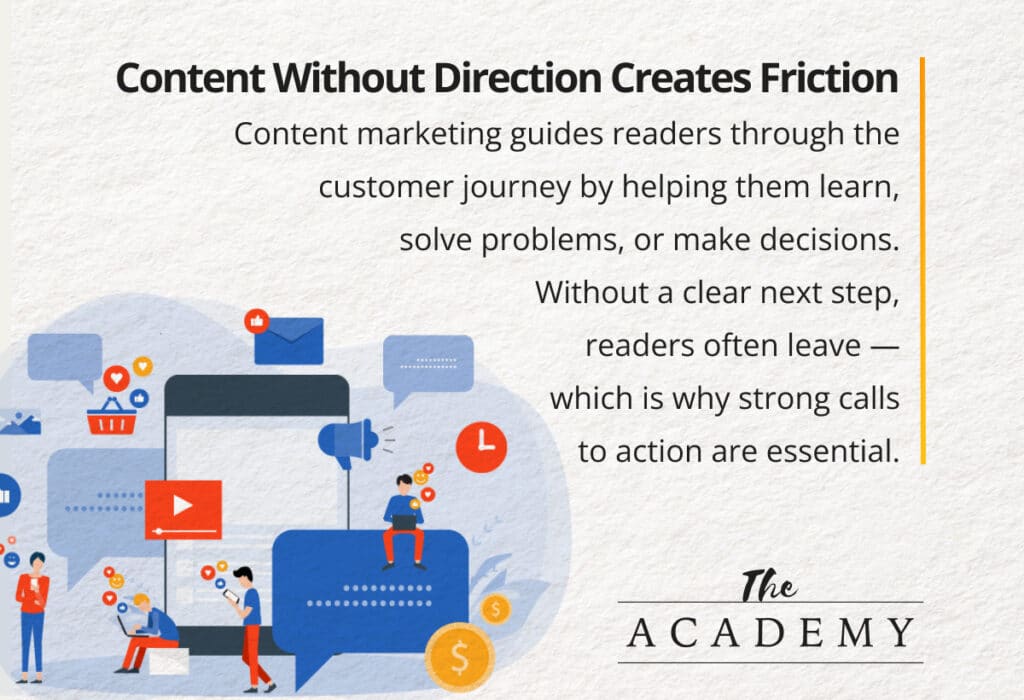
Effective content marketing guides a reader through the customer journey. Each piece of content should help the audience learn something new, solve a problem, or move closer to a decision. When content lacks a clear next step, the journey stops.
Imagine a blog post that thoroughly explains a problem your audience faces. The reader finds it helpful and relevant. They are now more informed and curious about possible solutions. If the page ends with no next step, the reader is left to figure out what to do on their own. Most will simply leave.
Clear calls to action remove this friction by giving the reader a logical path forward.
Calls to Action: Connect Value to Action

Content marketing succeeds when value leads to action. A strong call to action transforms passive consumption into engagement.
Depending on the context, that action might be:
- Downloading a guide or resource
- Subscribing to a newsletter
- Contacting your team
- Scheduling a consultation
- Exploring a related service or solution
Each action represents a small step in the relationship between your organization and the reader. Over time, these steps create momentum that moves prospects toward becoming customers.
In inbound marketing, this type of momentum is critical because content is designed to attract, engage, and guide people through the customer journey while building trust along the way.
A Clear CTA Aligns Content With Business Goals

Many organizations produce content with the right intention but without strategic alignment. The result is helpful information that does not support measurable outcomes.
Clear calls to action connect content to business objectives. They answer an important question: what result should this content produce?
For example:
- Awareness content might encourage readers to explore related educational resources.
- Consideration content might invite readers to download a comparison guide or case study.
- Decision-stage content might prompt readers to request a consultation or demonstration.
When CTAs align with the purpose of the content, each page becomes a functional part of the marketing system rather than a standalone article.
Effective Calls to Action Are Clear and Specific

One of the most common mistakes in content marketing is using vague or generic CTAs. Phrases such as “Learn More” or “Click Here” provide little context or motivation.
Strong calls to action are:
- Clear: They explain exactly what will happen next.
- Relevant: They relate directly to the topic the reader is already interested in.
- Value-Driven: They highlight the benefit the reader will receive.
For example, instead of “Learn More,” a more effective CTA might be:
- Download the Complete Buyer’s Guide
- Schedule a Strategy Consultation
- See How Our Process Works
These examples communicate both the action and the value.
Strategic Placement Matters

Even the best call to action can fail if it is poorly placed.
CTAs should appear where they feel natural in the reading experience. Common placements include:
- Within the body of the content after a key insight
- At the conclusion of the article
- As a visual banner or highlighted section
- In sidebar or in-line modules
The goal is not to overwhelm the reader with options. The goal is to guide them toward the most logical next step.
Calls to Action Turn Content Into a Growth Engine

Content marketing is powerful because it creates ongoing value. Articles, videos, and guides can attract new audiences long after they are published.
However, that value only translates into growth when readers are given a clear way to continue the relationship.
Calls to action transform content from information into interaction. They help organizations capture interest, nurture relationships, and guide potential customers toward meaningful engagement.
In short, great content attracts attention. Clear calls to action turn that attention into opportunity.

Related Articles:

Common Acronyms in B2B Digital Marketing
When I stepped into the world of Digital Marketing as a Project Manager, one of the first things I noticed wasn’t timelines or workflows. It…

What You Need to Know About Generative Engine Optimization (GEO)…
This year’s Super Bowl didn’t just deliver an unforgettable game — it also delivered an unforgettable AI takeover in advertising. Nearly a quarter of the…

A Proven Playbook to Increase Revenue with LinkedIn Ads
You're reviewing your monthly report from LinkedIn ads and start to feel the frustration boil up. The Cost Per Result (CPR) is through the roof,…



Most Popular Articles

Seeing Favicons in Your Google Search Results? Here’s Why…
Have you noticed anything different in your Google Search results lately? Google added tiny favicon icons to its organic search results in January. It was…

AI or Agency? The pros and cons of a human touch vs artificial intelligence in web design
Your organization’s website is a critical marketing channel. It’s the first impression many customers have of your business and it plays a vital role in…

Business Growth and Digital Marketing News & Tips 11-17-24
Are you encouraging and rewarding innovation? Lee Cockerell is the former Executive Vice President of Operations at Walt Disney World. A lover of traditional red…