This year’s Super Bowl didn’t just deliver an unforgettable game — it also delivered an unforgettable AI takeover in advertising. Nearly a quarter of the commercials during Super Bowl LX featured artificial intelligence either in their message or in their creation, from Google and Meta to Amazon, Anthropic, and even entirely AI-generated spots from brands like Svedka. This wave of AI ads dominated cultural conversation, underscoring how artificial intelligence — once a niche tech topic — is now central to mainstream marketing and consumer attention.
That same shift — from classic rankings to AI-driven answers — is reshaping how we approach search. Suddenly, it isn’t enough to show up on a search engine results page; you need to show up in the answers that people get from AI systems. Enter Generative Engine Optimization (GEO) and AI Search Optimization — the strategies marketers must understand to stay visible in 2026 and beyond.
What Is GEO?
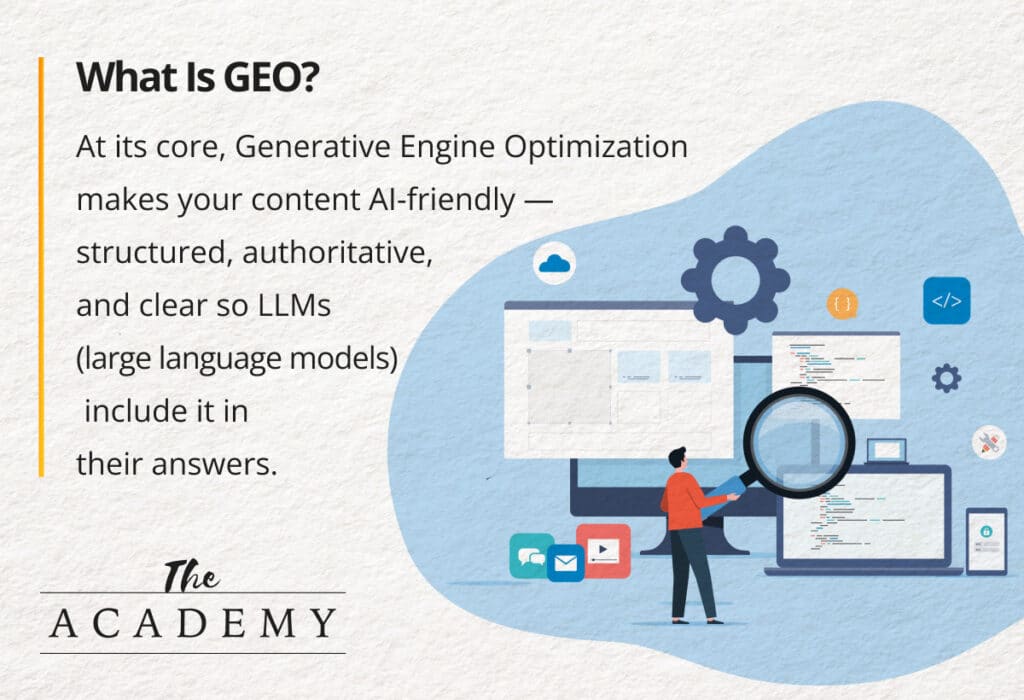
At its core, Generative Engine Optimization is about making your content AI-friendly — structured, authoritative, and contextually clear so that large language models (LLMs) will pull it into their answers. Unlike traditional SEO, which focuses on keywords and ranking positions, GEO focuses on being cited in AI-generated summaries and conversational responses.
In a world where users increasingly begin exploratory queries with tools like ChatGPT, Gemini, Claude, and AI Overviews, visibility isn’t just about clicks. It’s about inclusion in the answers these systems provide — even when a user never scrolls past the first response.
Why GEO Matters More Today Than Ever Before

The explosive visibility of AI in mass media — including high-profile platforms like the Super Bowl — signals a broader cultural shift. Audiences are not just hearing about AI; they’re seeing it everywhere. And that shift is mirrored in the way people seek information online.
Traditional search engines are still relevant, but AI-driven search experiences are now a mainstream starting point for discovery. That means your content strategy needs to evolve beyond classic keyword ranking to include signals that help AI models interpret and trust your content.
GEO vs. Traditional SEO — What’s the Difference?

It helps to break down how these approaches differ:
Traditional SEO
- Goal: Rank higher in organic search results
- Key signals: backlinks, on-page SEO, domain authority
- Outcome: More clicks to your website
Generative Engine Optimization (GEO)
- Goal: Be referenced by AI systems in their answers
- Key signals: structured, factual, directly helpful content
- Outcome: Brand visibility in AI responses — whether or not a click happens
In an AI-driven world, earning citations within answers can be as valuable as ranking #1 in a search result because those citations shape user perception and trust.
What AI Search Optimization Really Means

AI Search Optimization is the broader practice that encompasses GEO and other strategies designed to improve how and when AI systems surface your content. It includes:
- Answer-focused content: Content crafted to clearly and directly respond to questions users are likely to ask.
- Structured data: Using schema markup and clear hierarchy to help AI extract accurate information.
- Contextual authority: Demonstrating expertise, accuracy, and credibility so that generative systems treat your content as a reliable source.
In a world where AI systems weigh credibility heavily, these elements help your brand stand out inside the answers themselves — not just on a search results page.
How to Make GEO Work for Your Brand

Here are practical steps to start optimizing for AI search:
1. Think in Questions and Answers
Write content that anticipates real-world questions and provides direct, concise, and authoritative responses.
2. Use Structured Content
Break content into logical headings, bullets, and data points. Clear structure helps AI identify key ideas and include them in summaries.
3. Implement Technical Signals That Help AI
Beyond good copy, technical clarity plays a major role in how AI systems interpret and surface your content. Structured data like schema markup helps search engines and AI models understand context, relationships, authorship, FAQs, products, and services in a machine-readable way. The clearer your data structure, the easier it is for AI systems to extract accurate information and confidently reference your brand in generated answers.
We’re also seeing experimentation around emerging standards like LLMs.txt — a proposed framework similar to robots.txt, designed to signal how large language models can access and interpret your content. While adoption is still evolving, the concept reflects a broader reality: brands are beginning to think intentionally about how AI systems crawl, process, and use their content.
Yoast has introduced features that help site owners generate LLM-friendly outputs and structured content formats that make it easier for AI systems to understand page context. These enhancements build on traditional SEO foundations — like schema automation and metadata control — while positioning websites for better compatibility with AI-driven discovery environments. In other words, technical SEO is no longer just about helping Google rank your page. It’s about helping AI systems accurately interpret and represent your expertise.
4. Showcase Expertise and Trustworthiness
AI systems are more likely to pull from sources that are authoritative and credible. Citing reputable data, linking to trustworthy references, and regularly updating your content boosts those signals.
5. Fill Content Gaps That AI Might Pull
Look for areas where AI answers currently lack depth or clarity — and fill those gaps with high-quality content.
What This Means for Your Strategy

Generative Engine Optimization doesn’t replace traditional SEO; it enhances it. Traditional SEO builds your organic presence and traffic, while GEO builds your brand’s presence inside the way audiences discover information in an AI-centric world.
In 2026, the brands that win attention aren’t just those at the top of search results — they’re the ones that show up inside the answers. And just as AI dominated one of the biggest advertising stages of the year — the Super Bowl — so too will AI-optimized content dominate how users find and engage with information online.

Related Articles:

Common Acronyms in B2B Digital Marketing
When I stepped into the world of Digital Marketing as a Project Manager, one of the first things I noticed wasn’t timelines or workflows. It…

A Proven Playbook to Increase Revenue with LinkedIn Ads
You're reviewing your monthly report from LinkedIn ads and start to feel the frustration boil up. The Cost Per Result (CPR) is through the roof,…

E-Commerce SEO Essentials for Better Visibility
With the holidays creeping up and everyone’s online shopping habits kicking into “I swear these are gifts” mode, it’s a perfect time to talk about…



Most Popular Articles

Seeing Favicons in Your Google Search Results? Here’s Why…
Have you noticed anything different in your Google Search results lately? Google added tiny favicon icons to its organic search results in January. It was…

Business Growth and Digital Marketing News & Tips 11-17-24
Are you encouraging and rewarding innovation? Lee Cockerell is the former Executive Vice President of Operations at Walt Disney World. A lover of traditional red…

Business Growth and Digital Marketing News & Tips 11-27-24
A culture of gratitude "Feeling gratitude and not expressing it is like wrapping a present and not giving it." – William Arthur Ward Beyond being…